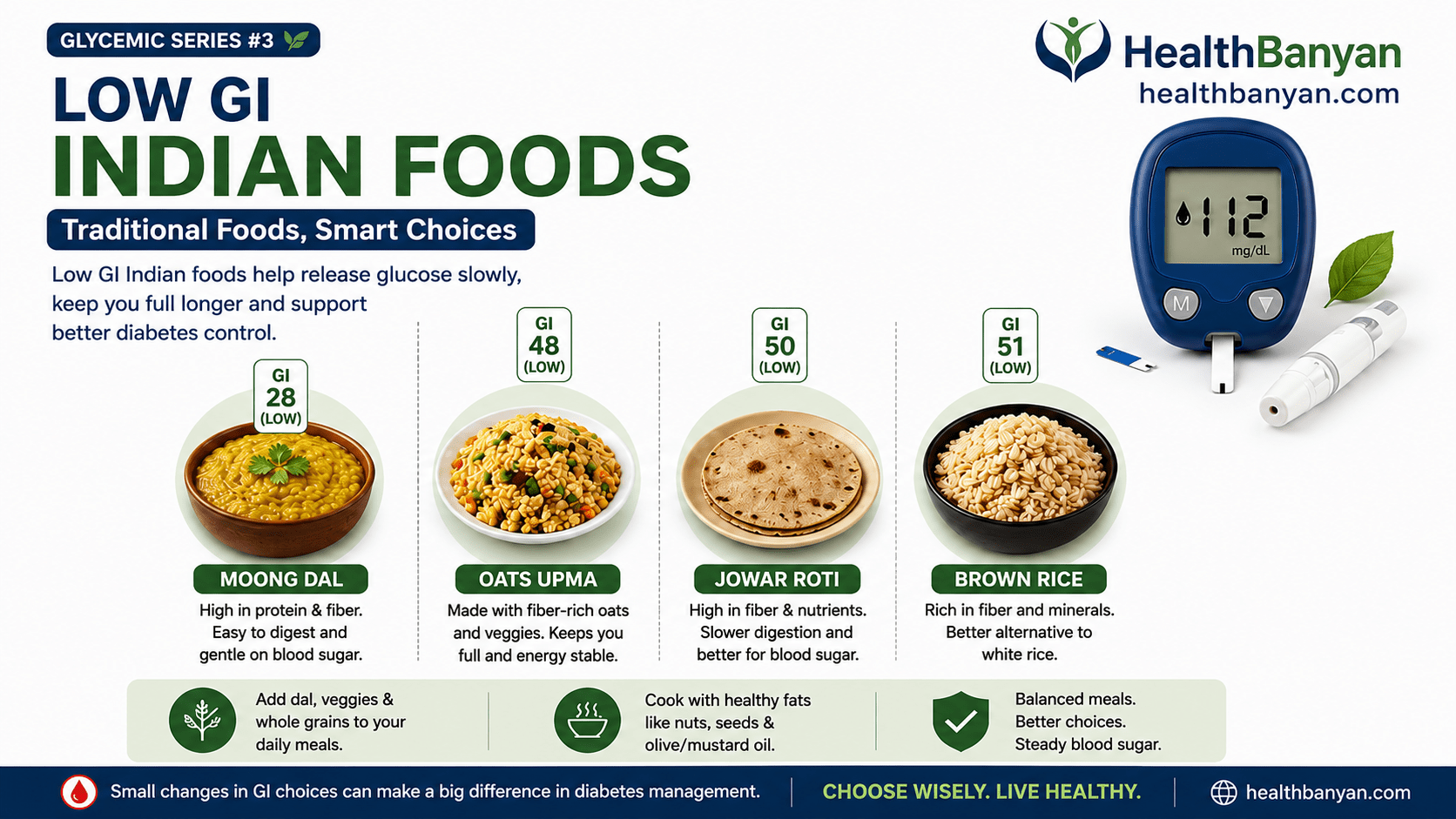
← Part 1: What Is GI? | ← Part 2: Low GI Fruits | You are reading: Part 3 — GI of Indian Foods
GI of white polished rice — the staple causing the most silent blood sugar damage across India
GI of chana dal — the lowest GI of all common Indian foods. A diabetes-management powerhouse
Reduction in effective GI of rice after cooling 12–24 hours — the “cool rice trick” every diabetic must know
Lower post-meal glucose when vegetables are eaten first before rice or roti — the “food order trick”
📅 Published: July 14, 2026 | 🩺 Medically Reviewed: July 14, 2026 | ⏱ Reading time: 6 min
🍛 You have learned what GI is. You know your safe fruits. Now comes the question that actually changes your everyday life: what is the GI of the food on your plate right now? Dal-rice or roti-sabzi — which is safer? Idli with sambar or poha? Oats or upma? This is where the GI Series becomes truly practical.
This final part of HealthBanyan’s GI Series gives you the complete GI reference for Indian meals — every major food group, a visual Plate Builder, regional meal plans, and the two most powerful tricks to lower any meal’s GI without changing a single ingredient. If you’re new here, start with Part 1: What Is Glycemic Index?
आपकी थाली में क्या है — और वह आपकी शुगर पर क्या असर डालता है — यह जानिए आज।
“My Idli-Sambar Breakfast Was the Problem — Not the Rice at Lunch.” — Ramesh’s Story
“समस्या दोपहर के चावल से नहीं — सुबह के इडली से थी।”
💡 The Key Insight
Indian food is rarely eaten as single ingredients — it is always a combination. The GI of a combination meal is significantly lower than the GI of its highest-GI ingredient alone. This is why “sambar rice” is safer than “plain rice” — and why knowing combination-meal GI is more useful than single-food GI.
📊 Complete Glycemic Index Chart for Indian Foods
भारतीय खानों का सम्पूर्ण GI चार्ट
Values sourced from University of Sydney International GI Database, ICMR-NIN studies, and peer-reviewed clinical research on South Asian food compositions.
🍚 Rice & Grains — चावल और अनाज
| Food | GI | Serving Size | Diabetic Verdict |
|---|---|---|---|
| Parboiled rice (Sela / Ukda chawal) | 38–41 🟢 | ½ cup cooked (90g) | ✅ Best rice choice — switch from white immediately |
| Brown rice | 50–55 🟢 | ½ cup cooked | ✅ Good choice; cook al dente for lower GI |
| Basmati rice (cooked, aged) | 50–58 🟡 | ½ cup cooked | 🟡 Acceptable in small portion — better than white rice |
| White polished rice | 72 🔴 | ½ cup cooked | ❌ Replace with parboiled — same taste, half the GI |
| Oats (plain rolled / steel cut) | 42–55 🟢 | ¾ cup cooked (180g) | ✅ Excellent breakfast — add nuts & seeds, no sugar |
| Bajra (pearl millet) | 54 🟢 | 1 medium roti (30g flour) | ✅ Superior to wheat for diabetics — high fibre, magnesium |
| Jowar (sorghum) | 49–55 🟢 | 1 medium roti | ✅ Excellent diabetic grain — widely available in Deccan |
| Ragi (finger millet) | 52–54 🟢 | 1 small roti / ½ cup ragi porridge | ✅ South India staple — high calcium, excellent GI profile |
| Whole wheat roti (thin, homemade) | 49–55 🟡 | 1 medium roti (25g flour) | 🟡 Acceptable — limit to 2 per meal; avoid thick rotis |
| Maida / refined flour (naan, paratha, poori) | 70–85 🔴 | Any serving | ❌ Avoid — spikes blood sugar as fast as white bread |

Left: White polished rice (GI 72) — causes rapid blood sugar spike | Right: Parboiled rice / Sela chawal (GI 38–41) — slow release, same taste, dramatically better for diabetics. Read full Rice vs Roti comparison →
🫘 Dal, Legumes & Protein — दाल और प्रोटीन
| Food | GI | Why It Helps |
|---|---|---|
| Chana dal (Bengal gram, split) | 8 🟢⭐ | Lowest GI of all Indian foods. Exceptionally high in protein and resistant starch. A daily serving measurably reduces post-meal glucose |
| Moong dal (whole green gram) | 38 🟢 | Best everyday dal for diabetics — light on digestion, high in protein, widely available, suits all regional cuisines |
| Rajma (kidney beans) | 24 🟢 | Very low GI with high protein — excellent for North Indian patients as a rice substitute or alongside parboiled rice |
| Chole / Kabuli chana (chickpeas) | 28–33 🟢 | High in resistant starch; significantly reduces post-meal glucose when included in a rice or roti meal. Excellent protein source for vegetarians |
| Sambar (dal + vegetable combination) | ~40 🟢 | One of South India’s nutritional gifts to diabetics — fibre, protein, vegetables, and spices (turmeric, cumin) together significantly lower meal GI. Always eat generously alongside idli or rice |
| Arhar / Toor dal (pigeon pea) | 22–32 🟢 | Standard dal in most Indian households — low GI, good protein. The daily dal-chawal combination is far safer than rice alone |
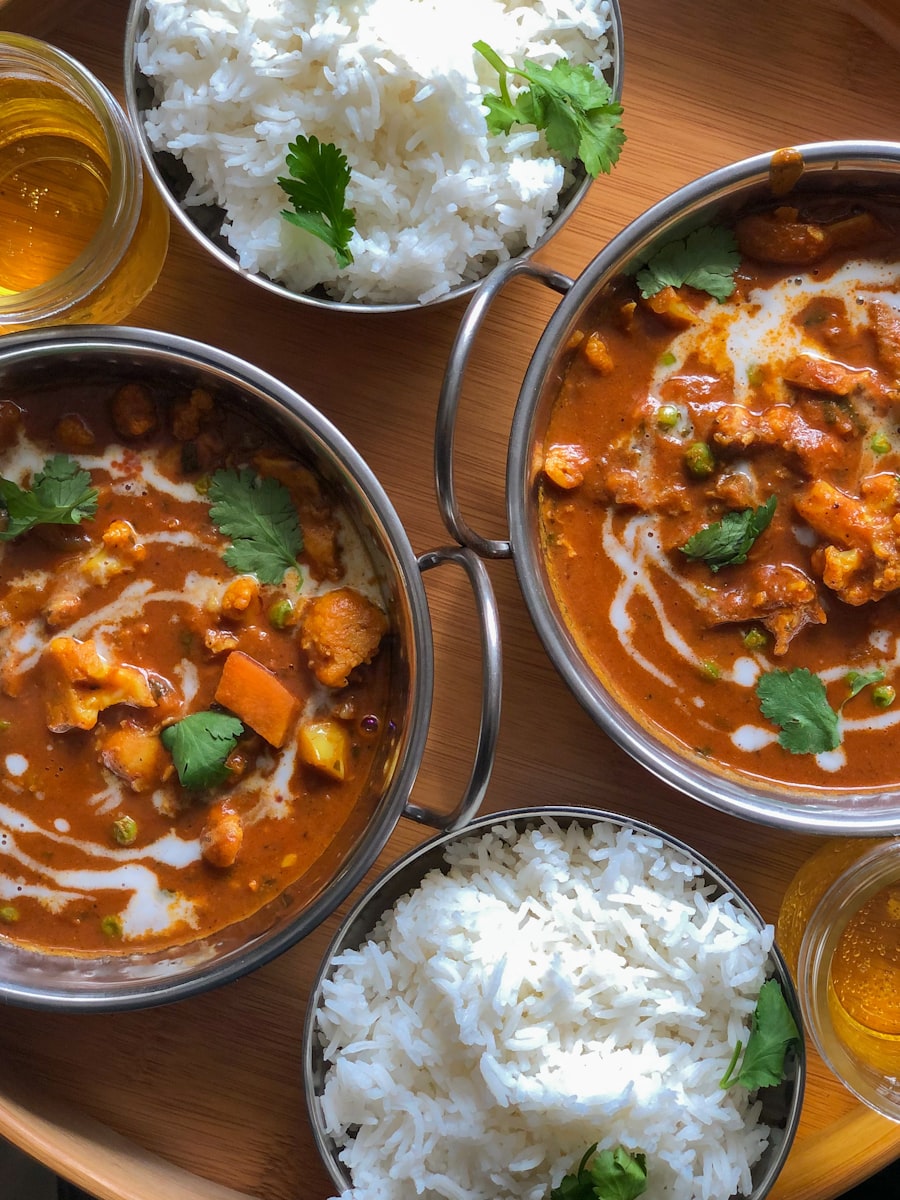
Dal — India’s most underrated blood sugar tool. A bowl of moong or toor dal with rice reduces the meal’s GI by 25–40% compared to plain rice alone
🌅 Indian Breakfast Foods — GI at a Glance
| Breakfast Item | GI (alone) | GI (with typical accompaniment) | Diabetic Advice |
|---|---|---|---|
| Idli (2 pieces) | 70–77 🔴 | ~55 🟡 with sambar + chutney | Limit to 2; always with generous sambar. Never eat plain |
| Dosa (plain) | 67–77 🔴 | ~58 🟡 with sambar | 1 small dosa + large sambar + minimal chutney. Masala dosa adds potato (high GI) — avoid |
| Poha (beaten rice) | 70–75 🔴 | ~60 🟡 with peanuts + vegetables | Add peanuts and vegetables generously; reduce poha quantity |
| Upma (semolina) | 65–70 🔴 | ~58 🟡 with coconut chutney | Small portion; add extra vegetables; choose broken wheat (dalia) upma instead — GI 41 |
| Dalia / Broken wheat porridge | 41 🟢 | ~38 🟢 | ✅ Excellent breakfast — high fibre, good satiety, one of the best alternatives to poha or upma |
| Oats porridge (plain rolled oats) | 42–55 🟢 | ~40 🟢 with nuts | ✅ Best breakfast choice — add almonds, walnuts, and avoid sugar or flavoured sachets |
| Whole egg omelette with vegetables | <15 🟢 | <15 🟢 | ✅ Virtually zero GI — the best protein breakfast for blood sugar stability |
Oats with walnuts and almonds — GI 40–42, high beta-glucan fibre, one of the best breakfasts for blood sugar control. See our complete Best Breakfast guide for diabetics →
🥦 Vegetables — सब्जियाँ
| Vegetable | GI | Note |
|---|---|---|
| Spinach, methi, palak | <15 🟢 | All leafy greens are nearly GI-free — eat abundantly at every meal |
| Brinjal, bitter gourd (karela), lauki | 10–15 🟢 | Karela specifically has anti-diabetic compounds — a double benefit |
| Tomato, capsicum, onion, cauliflower | 15–25 🟢 | Base of most Indian sabzis — freely usable, all low GI |
| Potato (boiled / in curry) | 65–80 🔴 | High GI — replace with sweet potato (GI 54) or yam; limit potato sabzi portions |
| Sweet potato (shakarkand) | 54 🟡 | Better than regular potato — high in beta-carotene and fibre |
🍽️ The Low-GI Indian Plate Builder — Build Every Meal This Way
हर भारतीय भोजन को इस तरह बनाएं — कम GI, पूरा स्वाद
The ideal diabetic Indian meal is not about removing foods — it is about the right proportions on the plate. Follow this simple visual:
🥦
Half Plate
Vegetables first — spinach, beans, cauliflower, salad. Eaten FIRST before grain
🫘
Quarter Plate
Dal / chole / rajma / egg / paneer / curd — protein eaten SECOND
🍚
Quarter Plate
Parboiled rice / bajra roti / oats — grain eaten LAST
⚡ The Food Order Rule — Proven to Reduce Post-Meal Glucose by 30%
Eat in this exact sequence: Vegetables first → Dal/protein second → Rice/roti last. A Cornell University study showed this order reduces peak post-meal glucose by 29–37% and peak insulin by 20–48% — without changing a single ingredient. See how this protects the heart too →
⚡ Two Tricks That Lower GI of Any Indian Meal — Without Changing Ingredients
बिना खाना बदले GI कम करने की दो सबसे असरदार तरकीबें
Trick 1: The Cool Rice Method
Reduces GI by up to 35%When cooked rice cools in the refrigerator for 12–24 hours, a process called retrogradation converts digestible starch molecules into resistant starch — which your body cannot digest rapidly. Resistant starch passes through the small intestine without raising blood sugar, then acts as prebiotic fibre in the large intestine.
📋 How to Do It:
1. Cook rice normally 2. Cool to room temperature 3. Refrigerate for 12–24 hours 4. Reheat and eat Result: GI drops from 72 → ~47 for white rice, and from 40 → ~27 for parboiled rice
Reference: Mohan V et al. Glycemic index of rice and carbohydrate in South Indian diabetics. JAPI 2020.
Trick 2: The Food Sequence Method
Reduces peak glucose by 29–37%The order in which you eat foods within the same meal dramatically changes how much glucose enters your bloodstream. Vegetables eaten first coat the gut with fibre, slowing glucose absorption. Protein eaten second further slows gastric emptying. Rice or roti eaten last means glucose arrives at a slower rate — processed by insulin more effectively.
📋 The Sequence:
🥦 Start: Eat all vegetables / salad first (5 minutes) → 🫘 Then: Eat dal or protein → 🍚 Last: Eat rice or roti. Same food, same portion — 30% lower blood sugar peak.
Reference: Shukla AP et al. Food order has a significant impact on postprandial glucose and insulin levels. Diabetes Care 2015.
🇮🇳 Low-GI One-Day Meal Plans by Indian Region
भारत के हर क्षेत्र के लिए एक दिन की कम GI भोजन योजना
🌴 South India
☕ Breakfast
2 idlis + generous sambar + small coconut chutney. Or: 1 dosa (small) + sambar
🌞 Lunch
½ cup parboiled rice + sambar + rasam + 2 vegetable dishes + small curd. Eat sabzi first, then dal, then rice last
🌙 Dinner
Ragi/bajra roti × 2 + kootu (vegetable + dal) + curd. Replace rice with millet at dinner
❄️ North India
☕ Breakfast
Plain oats porridge + handful of walnuts + 1 small apple. Or: 2-egg omelette with vegetable + 1 bajra roti
🌞 Lunch
2 whole wheat / bajra rotis + rajma / chana + large salad + curd. Salad first, then dal, then roti
🌙 Dinner
1–2 jowar or bajra rotis + dal + sabzi (no potato). Replace ghee-heavy rotis with light ones
🌿 East India
☕ Breakfast
Dalia (broken wheat) porridge with nuts. Or: boiled eggs + small portion of sauted vegetables
🌞 Lunch
½ cup parboiled (sela) rice + moong/masoor dal + shukto (mixed vegetable) + small fish (protein). Vegetables first, then dal, then rice last
🌙 Dinner
½ cup cooled & reheated parboiled rice + dal + vegetables. Use cool-rice trick for 35% GI reduction
🌊 West India
☕ Breakfast
Thalipeeth (multi-grain flour roti) + curd. Or: moong dal chilla × 2 + green chutney. Both naturally low GI
🌞 Lunch
1 jowar / bajra bhakri + dal + sabzi + small portion parboiled rice or no rice. Add koshimbir (vegetable salad) first
🌙 Dinner
Nachni (ragi) roti + usal (sprouted legumes) + curd. Usal is extremely low GI and high protein
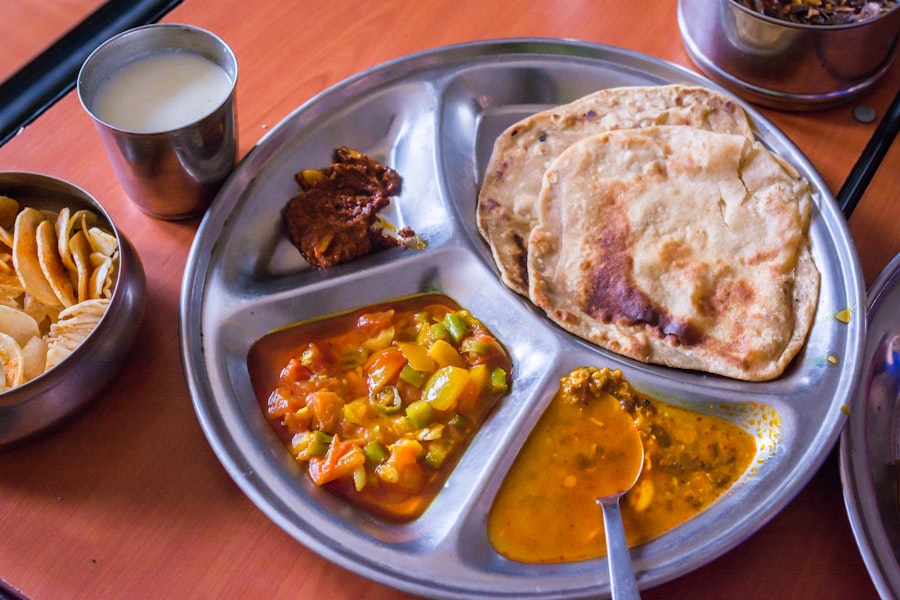
A well-assembled Indian thali with dal, vegetables, and minimal portion of grain — naturally low GI when proportioned correctly using the Plate Builder above
5 Myths About GI of Indian Foods — Busted
भारतीय खानों के GI के बारे में 5 मिथ्या
Frequently Asked Questions — GI of Indian Foods
Q: What is the GI of khichdi — is it a safe diabetic meal?
Traditional khichdi made with moong dal and rice has a GI of approximately 50–65 — which is moderate. The moong dal significantly lowers the overall GI versus plain rice. Using parboiled rice in khichdi further reduces the GI. Adding vegetables reduces it further. Khichdi is one of the best recovery and control meals for diabetics when portion-controlled and made with parboiled rice + moong dal + vegetables.
Q: Is suji (rava / semolina) safe for diabetics?
Semolina (rava/suji) has a GI of 65–70 — medium-high. It is not the best choice for diabetics when eaten in large portions as plain upma. However, broken wheat (dalia) is a direct lower-GI substitute (GI 41) with better nutritional profile and is available in all Indian markets. Replace rava upma with dalia upma for an immediately better glycaemic outcome.
Q: Can diabetics eat rajma chawal and chole bhature?
Rajma (GI 24) is one of the lowest-GI legumes available. Rajma with parboiled rice is actually an excellent diabetic meal — the rajma dramatically lowers the combined meal GI. A moderate portion is safe. Chole bhature, however, is problematic because bhatura is deep-fried refined flour (maida) with very high GI (75–85). Chole with bajra or jowar roti is the safer substitute that keeps the beloved flavour without the blood sugar spike.
Q: Are sprouts low GI? Can I eat them for breakfast?
Yes — sprouting legumes significantly reduces their GI further (below 30 for most). Moong sprouts (GI ~25–30), moth sprouts, and mixed sprouts with onion, tomato and lemon make an excellent diabetic breakfast with almost no blood sugar impact and high protein content. This is one of the best low-cost, high-nutrition breakfast options available across India.
Q: I take diabetes medicines — do I still need to worry about GI?
Yes, absolutely. Medicines control blood sugar but do not eliminate the glycaemic impact of food choices. High-GI meals require more medication to manage and lead to greater blood sugar variability — which increases complication risk even when average HbA1c appears controlled. A low-GI diet reduces medication burden, improves HbA1c stability, and works synergistically with medicines. See our guide on avoiding diabetes medication mistakes →
“Indian cuisine is one of the most naturally low-GI food cultures in the world — dal, sabzi, millet rotis, curd, and spices like turmeric and cumin are all metabolically protective. The problem is that modern Indian eating has drifted toward refined grains, packaged snacks, and large carbohydrate portions without the accompanying protein and fibre that made traditional meals safe. Returning to the principles of the traditional Indian thali — generous vegetables, adequate dal, modest grain, and a side of curd — is the most evidence-based dietary intervention I can recommend to any diabetic patient.”
“पारंपरिक भारतीय थाली — दाल, सब्जी, मोटा अनाज, दही — आज भी सबसे अच्छी डायबिटिक डाइट है।”
✍️ Written By
Dr Nirmala Singh
Expert Clinician & Senior Paediatrician
Medical Writer, HealthBanyan
🩺 Reviewed By
HealthBanyan Medical Research Team
Evidence-Based Clinical Review
HealthBanyan
References & Sources
1. Atkinson FS, Foster-Powell K, Brand-Miller JC. International GI database. Diabetes Care. 2008;31(12):2281–2283.
2. Mohan V, et al. Rice consumption and its effects on postprandial glucose and insulin levels in South Indian diabetics. JAPI. 2020.
3. Shukla AP, et al. Food order has a significant impact on postprandial glucose. Diabetes Care. 2015;38(7):e98–e99.
4. Nambiar VS, et al. GI of traditional Indian foods. Journal of Food Science and Technology. 2020;57(11).
5. ICMR-NIN. Dietary Guidelines for Indians. National Institute of Nutrition, Hyderabad. 2024.
✅ GI Series Complete — What to Read Next
You’ve mastered Glycemic Index. Now take the next step — learn exactly what happened to the one Indian food that breaks all the rules.
You know parboiled rice beats white rice on GI. But does it actually beat roti when you compare Glycaemic Load, fibre, and real meal data? Our head-to-head comparison has the full answer — and it might change what you serve for dinner tonight.
Complete GI Series:
Part 1: What Is Glycemic Index? → | Part 2: Low GI Fruits → | Part 3: GI of Indian Foods (you are here)
Medical Disclaimer: This article is for educational purposes only. Individual blood sugar responses to food vary. Consult your diabetologist or registered dietitian before making significant dietary changes, especially if you are on insulin or sulphonylurea medications where dietary changes can affect hypoglycaemia risk.