
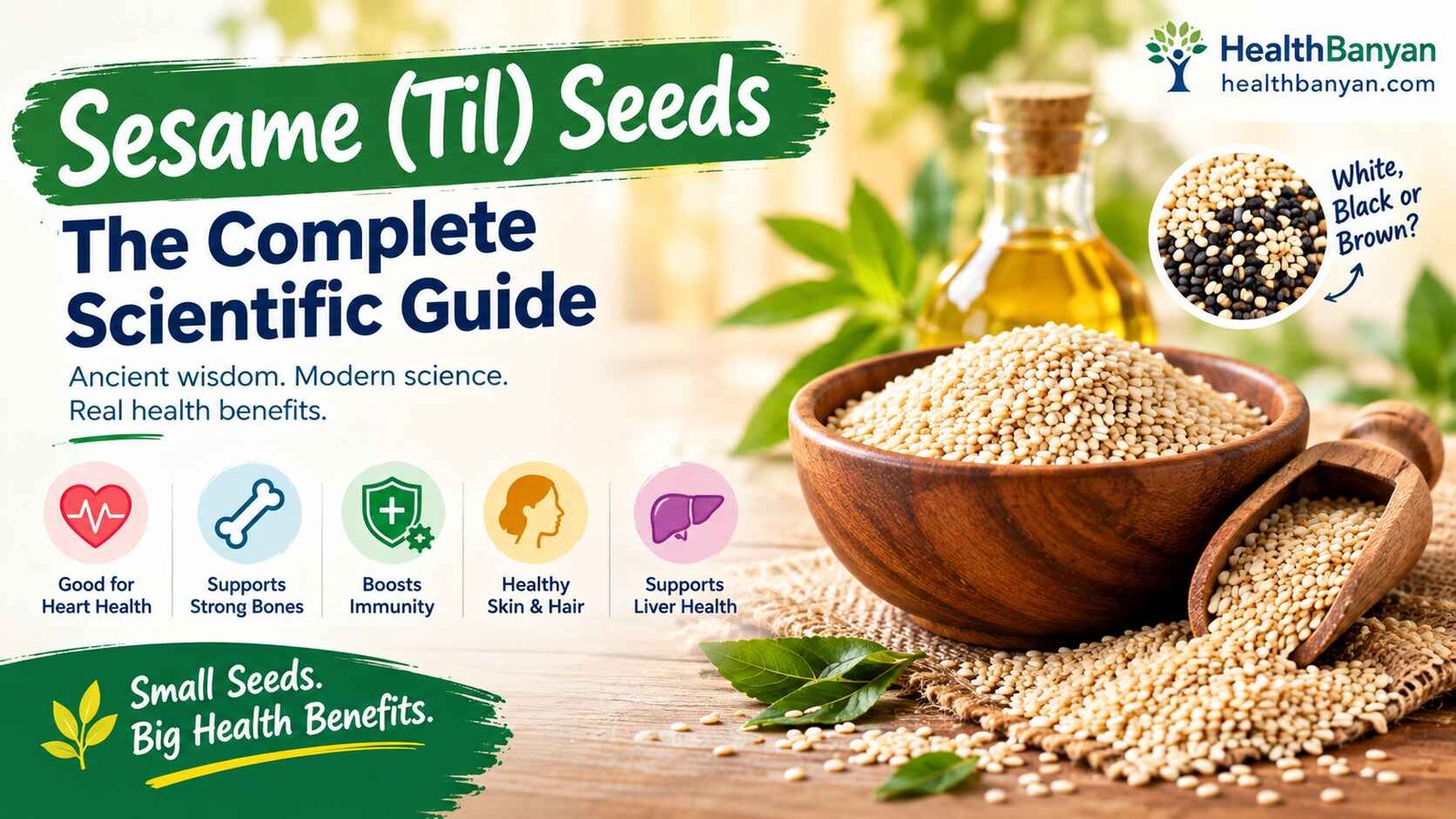
Sesame (Til) Seeds: The Complete Scientific Guide
The oldest cultivated oilseed on earth, used in Ayurveda and traditional medicine for millennia, and now studied for what its unique lignans actually do in the body.
Written by Dr. Nirmala Singh, Expert Clinician & Senior Paediatrician, Medical Writer · Reviewed by HealthBanyan Medical Research Team
What Is Sesame?
Sesamum indicum (family Pedaliaceae) has been cultivated for at least 5,000 years, with early evidence from the Indus Valley civilisation. India is among the world’s largest producers.
In Ayurveda, til is Snigdha (unctuous), Ushna (warm) and Guru (heavy), valued for winter nutrition, bone and skin care, and as til taila, the classic massage oil. Modern research now offers mechanisms for several of these traditional uses.
📜 Traditional Observations
Bones: sesame paste used in fracture care.
Teeth: oil pulling (kavala graha).
Hair & skin: til taila massage.
Winter: til ladoo, chikki and til-gur at Makar Sankranti.
🔬 What Research Shows
Lignans (sesamin, sesamolin) act as ERβ-leaning phytoestrogens.
Blood pressure falls in trials using sesame oil as the main cooking fat.
Lipids: sesamin lowers LDL oxidation.
Liver & cancer cells: promising lab and animal data; human evidence still limited.
White, Black or Brown: Which Variety?
⚪ White / Hulled
Hull removed, mild taste, better calcium absorption. Best for daily cooking, tahini, chikki and gajak.
⚫ Black
Hull retained, more antioxidant pigments, stronger flavour. Preferred in Ayurvedic and Chinese practice.
🟤 Brown / Natural
Intermediate profile. Common for oil extraction (gingelly oil in South India).
Nutrition: What 100 g and 1 Tablespoon Contain
| Nutrient | Per 100 g | Per 1 tbsp (9 g) | Note |
|---|---|---|---|
| Energy | 573 kcal | 52 kcal | Energy-dense |
| Fat | 49.7 g | 4.5 g | Mostly oleic and linoleic acid |
| Protein | 17.7 g | 1.6 g | Lysine is limiting; pair with dal |
| Fibre | 11.8 g | 1.1 g | Higher in unhulled seeds |
| Calcium | 975 mg unhulled / ~426 mg hulled | 88 / 38 mg | Hull oxalates lower absorption |
| Iron | 14.6 mg | 1.3 mg | Excellent plant source |
| Magnesium | 351 mg | 32 mg | Supports calcium metabolism |
| Zinc | 7.8 mg | 0.7 mg | |
| Phosphorus | 629 mg | 57 mg | |
| Copper / Manganese | 4.08 / 2.46 mg | 0.37 / 0.22 mg | Both exceed daily needs per 100 g |
| Thiamine (B1) | 0.79 mg | 0.07 mg | |
| Sesamin / Sesamolin | ~0.1–0.5 g / 0.05–0.3 g | ~10–45 / 5–27 mg | Unique lignans; no set daily value |
Sources: USDA FoodData Central; NIN Hyderabad Indian Food Composition Tables. Values for dried whole seeds unless noted; lignan content varies by variety and processing.
The Compounds No Other Common Seed Has
Sesamin
The core lignan. Inhibits Δ5 desaturase, shifting fatty-acid balance away from pro-inflammatory arachidonic acid. Also boosts antioxidant enzymes and supports blood vessel relaxation.
Sesamolin
Helps explain sesame oil’s remarkable shelf stability. Converts to sesamol; shows antifungal and anti-inflammatory activity. Higher in cold-pressed oil.
Sesamol
A potent antioxidant that rises with gentle toasting. Lab studies show liver-protective and neuroprotective activity.
Phytoestrogen Activity
Sesame lignans lean toward ERβ and do not need gut-bacteria conversion, so effects may be more consistent between individuals than soy isoflavones.



Pingback: Seasame Seeds Til Complete Guide: 2026 - HealthBanyan