
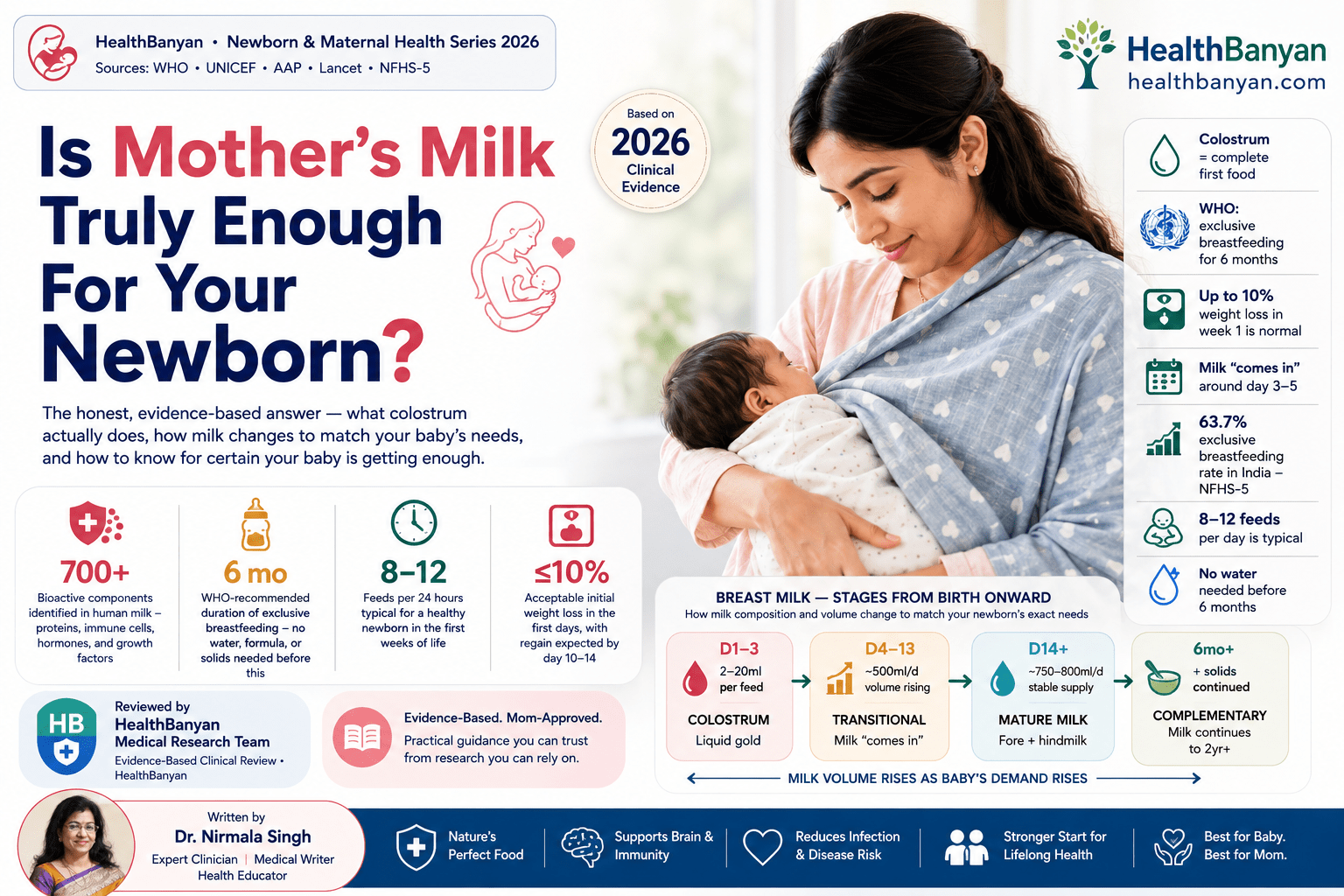
Is Mother's Milk
Truly Enough
For Your Newborn?
Almost every new mother asks this question in the first week. The honest, evidence-based answer — what colostrum actually does, how milk changes to match your baby's needs, and how to know for certain your baby is getting enough.
Colostrum — Day 1–3
Thick, yellowish, low-volume "first milk". Extremely concentrated in antibodies and immune cells — exactly matched to a newborn's tiny stomach size.
Transitional — Day 4–13
Volume increases rapidly as lactogenesis II begins. This is when milk "comes in" — breasts feel fuller, often around day 3–5.
Mature Milk — Day 14+
Stable composition of foremilk (watery, thirst-quenching) and hindmilk (fattier, calorie-dense). Adjusts subtly with baby's age and demand.
Complementary — 6 Months+
Breast milk continues alongside solids. WHO and AAP recommend continued breastfeeding up to 2 years or beyond, alongside age-appropriate food.
What Is Breast Milk — And Why Colostrum Is Called "Liquid Gold"
माँ का पहला दूध — कोलोस्ट्रम — understanding why so little milk in the first days is not a failure but a design feature
Human milk is not a single fixed fluid — it is a living, dynamic substance that changes composition hour by hour, day by day, and even within a single feed. In the first 2–4 days after birth, the breast produces colostrum: a thick, yellowish fluid, only a few millilitres per feed, but extraordinarily concentrated in secretory IgA antibodies, lactoferrin, white blood cells, and growth factors. A newborn's stomach on day one holds roughly the volume of a small marble — around 5–7ml. Colostrum's low volume is precisely matched to this tiny stomach capacity; it is not an inadequate supply, it is a calibrated one.
The question "is my milk enough" almost always surfaces around day 1–3, exactly when colostrum volume is at its lowest and a mother's worry is at its highest. Understanding what is actually happening biologically — rather than judging supply by breast fullness or crying alone — is the single most useful shift in perspective for a new mother.
"My Breast Feels Empty — Baby Must Be Hungry"
What The Evidence Actually Shows
The Three Stages of Milk — and What Each One Does
Colostrum
Day 1–3. Thick, low volume, extremely high in antibodies and immune cells. Also has a natural laxative effect that helps clear meconium and reduce jaundice risk.
✅ Complete first foodTransitional Milk
Day 4–13. Volume increases sharply as lactogenesis II begins — this is when milk "comes in", usually felt as breast fullness around day 3–5.
⚡ Supply ramping upMature Milk
Day 14 onward. Settles into a stable pattern of watery foremilk and fat-rich hindmilk within each feed, adjusting subtly as baby grows.
✅ Full nutrition, on demandComplementary Phase
From 6 months, breast milk continues alongside solids — WHO recommends continued breastfeeding to 2 years or beyond as part of a mixed diet.
🍽️ Milk plus foodThe single most reliable at-home indicator of adequate milk intake is not how the breast feels — it is diaper output, tracked by day of life, alongside weight gain trend checked at scheduled paediatric visits. By day 4–5, most exclusively breastfed babies should have at least 6 wet diapers and 3–4 soft, yellow stools in 24 hours. A baby who is alert, has good muscle tone, feeds 8–12 times a day, and shows this diaper pattern is very likely getting enough — regardless of how "empty" the breast feels afterward.
महत्त्वपूर्ण: स्तन खाली महसूस होना दूध की कमी का संकेत नहीं है। Diaper count और doctor की weight check ही असली भरोसे का पैमाना है।Is Breastfeeding Actually Better? — What the Research Proves
Beyond tradition and instinct, here is what randomised trials and large cohort studies actually document
The evidence for exclusive breastfeeding is among the most consistent in all of paediatric nutrition research, built from randomised trials, large cohort studies, and decades of global health monitoring. The strongest single piece of evidence remains the PROBIT trial in Belarus — a cluster-randomised trial of over 17,000 mother-infant pairs — which showed that a breastfeeding-promotion intervention increased exclusive breastfeeding duration and significantly reduced gastrointestinal infections and atopic eczema in the first year, with a follow-up study reporting higher cognitive test scores at age 6.
Breastfeeding Promotion Reduced Infections and Improved Later Cognition
This landmark cluster-randomised trial remains the gold-standard evidence base for breastfeeding outcomes. Infants in the intervention group, who were breastfed longer and more exclusively, had significantly fewer gastrointestinal infections and less atopic eczema in infancy. A follow-up assessment years later found higher scores on cognitive testing among children from the intervention arm — one of the strongest pieces of trial-level evidence linking breastfeeding duration to long-term child development.
Design: cluster-randomised trial, n=17,046 pairsGlobal Analysis Links Breastfeeding to Reduced Infant Mortality
This influential series synthesised evidence from dozens of countries and concluded that scaling up breastfeeding to near-universal levels could prevent a substantial share of deaths in children under 5, alongside reductions in respiratory infections, diarrhoeal disease, and later-life obesity and diabetes risk. The series also highlighted that breastfeeding benefits mothers, including reduced risk of breast and ovarian cancer.
Design: multi-country systematic synthesisExclusive Breastfeeding for 6 Months Recommended Worldwide
WHO and UNICEF jointly recommend exclusive breastfeeding — no water, formula, juice, or solids — for the first 6 months of life, followed by continued breastfeeding alongside nutritionally adequate complementary foods up to 2 years of age or beyond. This guidance is built on the cumulative weight of trial and cohort evidence on infection risk, growth, and development.
Global Strategy for Infant and Young Child FeedingIndia's Exclusive Breastfeeding Rate Has Risen but Gaps Remain
India's National Family Health Survey-5 recorded an exclusive breastfeeding rate for infants under 6 months, showing meaningful improvement over previous survey rounds, alongside continued gaps in early initiation of breastfeeding within the first hour of birth. This national data underlines why hospital-level support in the first hours after delivery matters as much as home-level practice.
Nationally representative household survey| Outcome studied | Effect of exclusive breastfeeding | Evidence source |
|---|---|---|
| Gastrointestinal infections | Reduced | PROBIT trial |
| Respiratory infections | Reduced | Lancet 2016 series |
| Atopic eczema in infancy | Reduced | PROBIT trial |
| Later childhood cognitive scores | Modestly higher | PROBIT follow-up |
| Under-5 mortality (population level) | Reduced | Lancet 2016 series |
| Maternal breast/ovarian cancer risk | Reduced | Lancet 2016 series |
How Does Breast Milk Actually Get Made? — The Supply-and-Demand System
Understanding the hormonal biology behind milk production — and why frequent feeding is the real lever, not diet or willpower
Prolactin — The Milk-Making Hormone
Prolactin, released from the pituitary gland in response to suckling, drives milk synthesis in the alveolar cells of the breast. Prolactin levels are highest at night, which is part of why night feeds matter for building supply, not just for calming baby. The more frequently and effectively milk is removed from the breast, the more prolactin is released, and the more milk the breast is signalled to make for the next feed.
Frequent, effective feeding → sustained prolactin release → higher milk synthesisOxytocin and the Let-Down Reflex
Oxytocin causes the muscle cells around milk-producing alveoli to contract, pushing stored milk into the ducts and out through the nipple — the "let-down" reflex. This reflex can be triggered by the baby's cry, touch, or even just thinking about the baby, and can be inhibited by stress, pain, or anxiety. This is the biological basis for why a calm, supported feeding environment genuinely helps milk flow, not as a psychological nicety but as a measurable hormonal effect.
Oxytocin release → alveolar contraction → active milk ejection during a feedFeedback Inhibitor of Lactation (FIL)
Milk itself contains a whey protein called Feedback Inhibitor of Lactation, which slows further milk synthesis when the breast is fuller. When milk is removed frequently through feeding, FIL concentration drops and production speeds back up. This local, breast-by-breast feedback system is the biological reason why frequent, effective removal of milk — not maternal diet or fluid intake — is the strongest lever for building and maintaining supply.
Frequent removal → FIL cleared → production rate increases at that breastSecretory IgA and Human Milk Oligosaccharides
Colostrum and breast milk transfer secretory IgA antibodies that coat the newborn's gut lining, providing passive immunity before the baby's own immune system has matured. Human milk also contains over 200 distinct oligosaccharide structures (HMOs) that are not digested by the baby directly, but instead selectively feed beneficial gut bacteria such as Bifidobacterium infantis, shaping a protective gut microbiome from the first days of life.
Secretory IgA + HMOs → passive immunity and early gut microbiome shapingReflects general lactation physiology on feeding frequency and supply-building, not a rigid target. Effective milk transfer at the breast matters as much as frequency — a lactation consultant can assess latch quality directly.
The Feeding Protocol That Actually Confirms Baby Is Getting Enough
Not vague reassurance — specific, checkable signs and practices with the clinical reasoning behind each one
A Correct Latch Is the Single Biggest Factor in Milk Transfer
A baby latched well takes in a large portion of areola, not just the nipple, with lips flanged outward and rhythmic, audible swallowing after the initial faster non-nutritive sucks. A shallow, nipple-only latch is the most common cause of both nipple pain and poor milk transfer, even when supply itself is completely normal. Skin-to-skin contact within the first hour after birth supports the baby's instinctive rooting and first latch, and is associated with more successful early breastfeeding in multiple studies.
सही latch ही सबसे बड़ा factor है — केवल nipple नहीं, areola का बड़ा हिस्सा मुंह में होना चाहिए।8–12 Feeds a Day, Led By Hunger Cues, Not a Fixed Schedule
Early hunger cues include rooting, hand-to-mouth movements, and lip smacking — crying is a late cue, and feeding is easier for both mother and baby when started earlier. Newborns typically feed 8–12 times in 24 hours, and cluster feeding — several closely spaced feeds, often in the evening — is a normal pattern in the first weeks and a natural way of building supply, not a sign that milk is insufficient.
Rone se pehle hi feed cues पहचानें — rooting, hath मुँह तक ले जाना — यह भूख का पहला संकेत है।Wet and Dirty Diaper Counts Are the Most Reliable At-Home Check
By day 1, expect at least 1 wet diaper; by day 4–5, at least 6 wet diapers and 3–4 soft yellow stools in 24 hours is the expected pattern for an exclusively breastfed baby whose supply and transfer are on track. Urine should be pale, not dark or concentrated. This objective count is far more reliable than how full or empty the breast feels, since breast sensation changes independently of actual milk transfer as lactation matures.
Diaper count track करें — Day 4-5 तक कम से कम 6 wet diapers और 3-4 soft stools normal हैं।Weight Loss Up To 10% Is Normal — Regain by Day 10–14 Is the Real Marker
Almost all newborns lose some weight in the first days as they clear excess fluid and colostrum volume is still low; up to 7% loss is very common, and up to 10% is within an accepted range in current clinical guidance, provided the baby is otherwise well and feeding effectively. What matters clinically is the trend: most babies regain their birth weight by day 10–14. This is exactly why paediatric follow-up visits in the first week are built around a weight check, not a single reassurance.
पहले दिनों में वजन कम होना सामान्य है — असली संकेत यह है कि बच्चा 10-14 दिन में birth weight वापस पा ले।Signs Baby Is Getting Enough — A Quick Reference
| Sign | What's Reassuring | By When | Why It Matters |
|---|---|---|---|
| Wet diapers | ✅ Reassuring | At least 6/day by day 4–5 | Reflects adequate fluid and milk intake |
| Stool colour and frequency | ✅ Reassuring | 3–4 soft, yellow stools/day by day 4–5 | Confirms milk is being digested, not just tasted |
| Audible swallowing at breast | ✅ Reassuring | Every feed, after initial faster sucks | Direct sign of active milk transfer |
| Alertness and muscle tone | ✅ Reassuring | Ongoing | Well-fed newborns are alert between feeds, not floppy |
| Weight regain to birth weight | ✅ Reassuring | By day 10–14 | Objective, doctor-confirmed marker of adequate intake |
| Feeding fewer than 6 times/day | ❌ Needs review | Any day | May indicate ineffective transfer or low intake |
| Dark or minimal urine after day 4 | ❌ Needs review | Any day | Possible sign of insufficient fluid/milk intake |
| Persistent weight loss beyond 10% | ❌ Needs review | Any weight check | Warrants same-day paediatric and lactation assessment |
| Breast feels "less full" over weeks | ⚠️ Usually normal | Weeks 2–6 | Supply regulation, not necessarily supply loss |
When Is Formula or Supplementation Medically Necessary?
Not every worry needs formula — but some clinical situations genuinely do, and knowing the difference matters
When weight loss exceeds the accepted 10% threshold, or the expected regain by day 10–14 is not happening, clinical evaluation is warranted before assuming formula is the only path. The first step is a hands-on assessment of latch and milk transfer by a lactation consultant, since correcting a shallow latch or feeding position often resolves the issue without needing formula at all. If evaluation confirms genuine low intake, expressed breast milk or donor milk is generally preferred over formula as a first-line supplement, with formula used when neither is available or sufficient.
Evidence: ABM Clinical Protocol on supplementation · AAP newborn feeding guidanceMild physiologic jaundice is common and usually improves with frequent, effective breastfeeding, since more feeding means more stooling, which clears bilirubin faster. However, when bilirubin levels are high enough to need phototherapy, or when jaundice is linked to genuinely inadequate intake in the first days, a paediatrician may recommend temporary supplementation with expressed milk or formula alongside continued breastfeeding, while addressing the underlying feeding issue directly rather than simply stopping breastfeeding.
Evidence: AAP hyperbilirubinemia management guidelinesBabies at higher risk of low blood sugar — for example, those born to mothers with diabetes, or born preterm or small for gestational age — are monitored closely in the first hours. If blood sugar is confirmed low despite breastfeeding support, supplementation with expressed colostrum, donor milk, or formula may be recommended as a targeted medical measure, alongside continued breastfeeding, rather than as a replacement for it.
Evidence: AAP and WHO neonatal hypoglycemia protocolsA small number of maternal conditions and medications are incompatible with direct breastfeeding, and in these specific, individually assessed situations, a paediatrician or physician may advise formula feeding or temporary interruption of breastfeeding with pumping to maintain supply. Because the list of truly incompatible medications is much shorter than commonly assumed, any medication concern should be checked with a doctor before breastfeeding is stopped, rather than assumed to be unsafe by default.
Evidence: WHO/UNICEF Baby-Friendly Hospital Initiative clinical guidanceFive Breastfeeding Myths That Cause Unnecessary Worry
The concerns almost every new mother hears — and what the evidence actually says
Breast size reflects the amount of fatty tissue, not the amount of glandular, milk-producing tissue. Milk production capacity is determined by glandular tissue and effective, frequent removal of milk — not by overall breast size. Women with small breasts breastfeed successfully at the same rates as women with larger breasts when latch and feeding frequency are adequate.
✅ सच्चाई: स्तन का आकार दूध की मात्रा तय नहीं करता — बार-बार सही तरीके से दूध निकलना ही असली factor है। 🔬 Reviewed: HealthBanyan MRT · Source: Lactation physiology consensus, AAP breastfeeding guidanceStudies on infant sleep have not shown that formula reliably extends sleep duration in young infants, and newborn sleep-wake cycles are driven mainly by brain maturation, not stomach fullness. Night feeds are also biologically important for building milk supply, since prolactin levels are highest overnight. Introducing formula specifically to extend sleep can reduce breast stimulation at exactly the feeds that matter most for establishing supply.
✅ सच्चाई: Formula से नींद लंबी होने का पक्का सबूत नहीं है, जबकि रात के feeds supply बनाने के लिए जरूरी हैं। 🔬 Reviewed: HealthBanyan MRT · Source: Infant sleep and feeding physiology literatureBreast milk is roughly 88% water and fully meets a healthy newborn's fluid needs, even in hot climates, when feeding frequency is adequate. WHO guidance is explicit that no additional water is needed before 6 months of exclusive breastfeeding. Giving water can fill a newborn's tiny stomach capacity without adding nutrition, reduce the frequency of breastfeeding, and in some cases increase infection risk if the water source is not clean.
✅ सच्चाई: 6 महीने तक पानी की जरूरत नहीं — माँ का दूध ही पर्याप्त तरलता देता है, गर्मी में भी। 🔬 Reviewed: HealthBanyan MRT · Source: WHO exclusive breastfeeding guidanceThis is one of the most harmful traditional beliefs in some communities, and it directly denies the newborn the most concentrated source of antibodies they will ever receive. Colostrum is not old milk — it is a distinct, purpose-built first food, uniquely rich in immune-protective components. Global health bodies specifically recommend colostrum be given from the very first feed, ideally within the first hour of life.
✅ सच्चाई: पीला गाढ़ा पहला दूध (colostrum) फेंकने की चीज़ नहीं है — यह बच्चे के लिए सबसे कीमती पहला आहार है। 🔬 Reviewed: HealthBanyan MRT · Source: WHO/UNICEF Baby-Friendly Hospital Initiative, Ten Steps to Successful BreastfeedingA sudden increase in feeding frequency, often around 2–3 weeks, 6 weeks, and 3 months, is commonly a growth spurt — a temporary period where baby feeds more often to signal the breast to increase supply for a coming growth phase. Left to continue, feeding frequency typically settles again within a few days once supply has adjusted upward. Introducing formula at this exact point, believing supply has failed, can genuinely reduce supply by lowering the breast stimulation signal.
✅ सच्चाई: अचानक ज़्यादा feed मांगना अक्सर growth spurt है, supply की कमी नहीं — कुछ दिनों में सामान्य हो जाता है। 🔬 Reviewed: HealthBanyan MRT · Source: Lactation physiology consensus on growth spurts and supply regulationFrom Our Clinician — What I Tell New Mothers About "Is It Enough"
The conversation most new mothers need in the first week, but rarely get in enough detail
"The question I hear most often in the first week is some version of 'is my milk enough' — usually asked while a mother is exhausted, her breasts feel soft, and her baby has just cried after a long feed. In almost every case, the biology is working exactly as designed. What is usually missing is not milk — it is a clear way to check, and someone taking the time to explain what colostrum's low volume actually means."
- The most reliable home check is diaper count, not how the breast feels. I ask every mother to track wet and dirty diapers by day of life for the first two weeks. This single habit resolves more unnecessary worry than any amount of reassurance alone, because it replaces a subjective feeling with an objective, checkable number.
- Skin-to-skin contact in the first hour matters more than most parents realise. It supports the baby's natural rooting reflex and the first latch, and is associated with more successful early breastfeeding. I encourage this in every uncomplicated delivery, and encourage parents to ask for it specifically if it is not offered.
- Feed on hunger cues, not a clock. Rooting, hand-to-mouth movement, and lip smacking come well before crying. I tell mothers that crying is a late cue, and that catching the earlier cues makes each feed calmer and usually more effective for milk transfer.
- Weight loss in the first days is expected — the number I actually track is the trend to day 10–14. A single weight check on day 2 rarely tells the full story. I look at the trajectory across the first two weeks, alongside feeding and diaper pattern, before considering any supplementation conversation.
- If latch pain persists beyond the first few days, involve a lactation consultant early rather than waiting. Persistent pain is very often a fixable latch issue, not a sign that breastfeeding "isn't working" for a particular mother and baby. Early, hands-on support resolves the large majority of these cases without needing formula.
- Colostrum should never be discarded. I specifically address this with families where the belief that first milk is "old" or "dirty" is common, because it is one of the most easily correctable practices with a real, measurable benefit to the baby.
MRT
🔊 Featured Snippet — "Is breast milk enough for my newborn?"
Quick Answer (for search): Yes — for the large majority of healthy, full-term newborns, breast milk alone is complete nutrition, and WHO recommends exclusive breastfeeding for the first 6 months, with no water, formula, or solids needed. Colostrum, produced in small amounts (2-20ml per feed) in the first 2-4 days, is precisely matched to a newborn's tiny stomach capacity and is extremely concentrated in antibodies. Milk volume rises through the "transitional" stage (day 4-13, when milk "comes in") into stable "mature milk" production by around day 14. Newborns typically feed 8-12 times per 24 hours. Weight loss of up to 10% in the first days is normal, with regain expected by day 10-14. The most reliable at-home signs that intake is adequate are wet diaper count (at least 6/day by day 4-5), soft yellow stool frequency (3-4/day by day 4-5), and steady weight gain confirmed at paediatric visits — not how full or empty the breast feels. Supplementation is medically indicated for weight loss beyond 10%, significant jaundice, confirmed low blood sugar, or specific maternal health factors, and should ideally involve a lactation consultant assessment first. Colostrum should never be discarded, and additional water is not needed before 6 months, even in hot weather.
Share This Guide on WhatsApp
Know a new mother worrying whether her milk is enough? Share this evidence-based guide — it could ease a lot of unnecessary worry in the first week.
- Kramer MS et al. — Promotion of Breastfeeding Intervention Trial (PROBIT): a randomized trial in the Republic of Belarus. JAMA. 2001; 285(4): 413-420.
- Kramer MS et al. — Breastfeeding and child cognitive development: new evidence from a large randomized trial. Archives of General Psychiatry. 2008; 65(5): 578-584.
- Victora CG et al. — Breastfeeding in the 21st century: epidemiology, mechanisms, and lifelong effect. The Lancet. 2016; 387(10017): 475-490.
- World Health Organization / UNICEF — Global Strategy for Infant and Young Child Feeding. WHO/UNICEF, 2003 (with ongoing guidance updates).
- World Health Organization / UNICEF — Baby-Friendly Hospital Initiative: Ten Steps to Successful Breastfeeding. WHO/UNICEF, revised guidance.
- American Academy of Pediatrics — Breastfeeding and the Use of Human Milk. Pediatrics. Clinical Report.
- International Institute for Population Sciences — National Family Health Survey-5 (NFHS-5), 2019-21, India: Infant and Young Child Feeding indicators.
- Academy of Breastfeeding Medicine — ABM Clinical Protocol on the Use of Supplementary Feeding in Healthy Term Breastfed Neonates.