MASLD vs. NAFLD: Decoding the New Name and 7 Silent Signs Your Liver Needs Help
{
“@context”: “https://schema.org/”,
“@type”: “ImageObject”,
“contentUrl”: “https://www.healthbanyan.com/wp-content/uploads/2026/03/healthy-vs-fatty-liver-comparison-masld-nafld.webp”,
“license”: “https://www.healthbanyan.com/image-license/”,
“acquireLicensePage”: “https://www.healthbanyan.com/contact/”,
“creditText”: “HealthBanyan.com”,
“creator”: {
“@type”: “Organization”,
“name”: “HealthBanyan”
},
“copyrightNotice”: “HealthBanyan”,
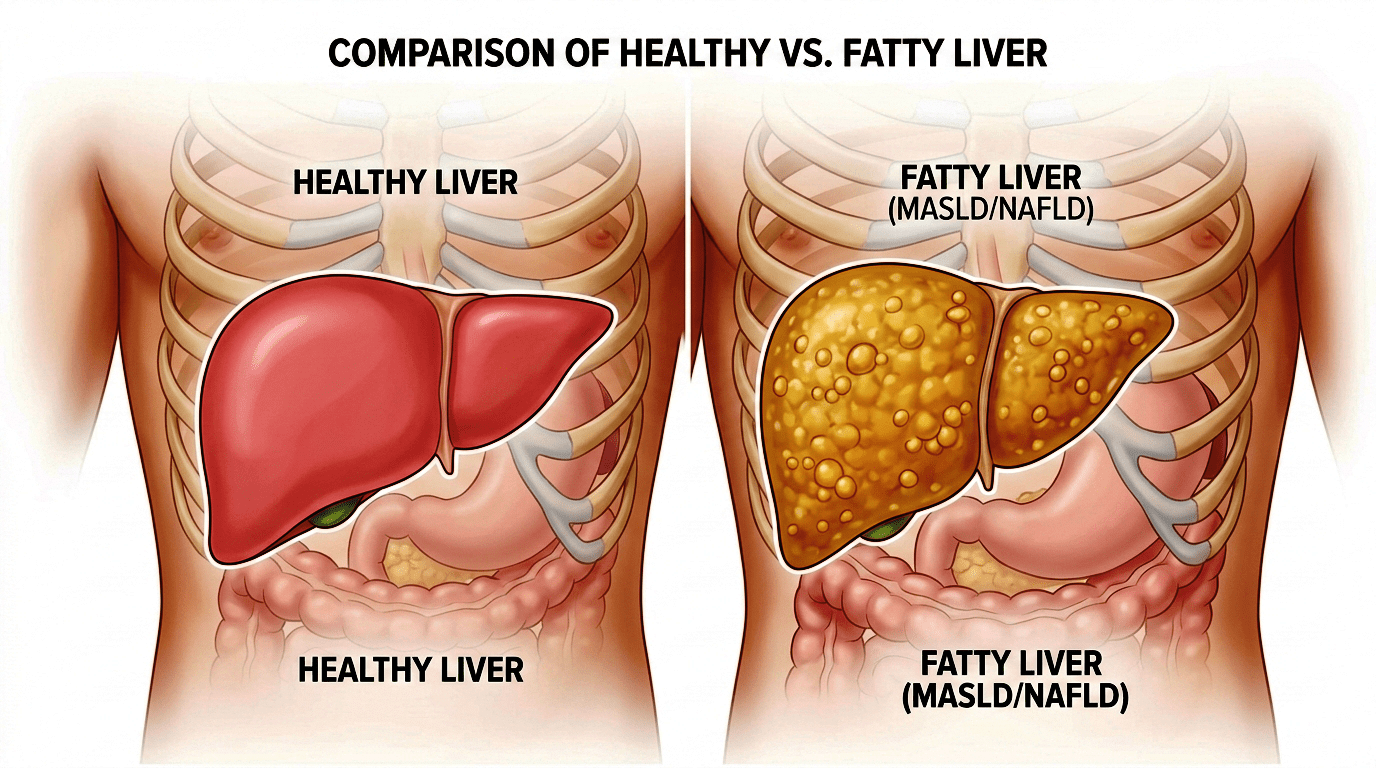
“description”: “An anatomical comparison illustrating a smooth healthy liver on the left torso versus a yellowish, fatty MASLD/NAFLD liver on the right torso.”,
“disambiguatingDescription”: “Medical comparison of MASLD vs NAFLD stages in the human body.”,
“keywords”: “MASLD vs NAFLD, fatty liver diagram, liver anatomy comparison, healthy liver vs fatty liver, HealthBanyan”,
“encodingFormat”: “image/webp”
}
What if the “harmless” belly fat you’ve been ignoring is actually a silent alarm for your liver?
Most people think liver damage only happens to those who drink alcohol. But today, millions of Indians who don’t touch a drop are being diagnosed with a “silent killer” that recently got a brand-new name.
INTRODUCTION
For decades, we called it NAFLD (Non-Alcoholic Fatty Liver Disease). But as of 2024–2026, the global medical community has officially moved to a more accurate term: MASLD (Metabolic Dysfunction-associated Steatotic Liver Disease).
This isn’t just a fancy name change; it’s a shift in how we save lives. MASLD targets the root cause—your metabolism. If you have high blood pressure, diabetes, or even a “little bit” of extra weight around the waist, your liver might be under siege without you feeling a thing.
REAL-LIFE STORY: RAJESH’S WAKE-UP CALL
Rajesh, a 42-year-old software engineer from Kanpur, lived a typical busy life. He didn’t smoke or drink. His only “vice” was a love for late-night parathas and a sedentary desk job. He felt “okay,” except for a bit of heaviness after meals and constant afternoon fatigue. He blamed it on “work stress.” It wasn’t until a routine insurance check-up showed elevated ALT levels that he discovered he had Grade 2 Fatty Liver (now MASLD).
“I don’t even drink!” he told his doctor. Rajesh’s struggle wasn’t with alcohol; it was with Insulin Resistance.
How does it happen?
Imagine your liver as a tireless 24/7 filter. When you eat more sugar and processed carbs than your body can burn, your liver stores the excess—turning it into tiny fat droplets. This isn’t just about eating too much sugar; it starts with insulin resistance, which floods the liver with fat from other parts of your body while the liver makes even more fat on its own. This buildup triggers inflammation and stress. What begins as simple fat buildup can slowly progress to scarring and eventually, irreversible damage. This happens especially to those suffering from type 2 diabetes, obesity, Dyslipedemia (high Cholesterol), and PCOD conditions.
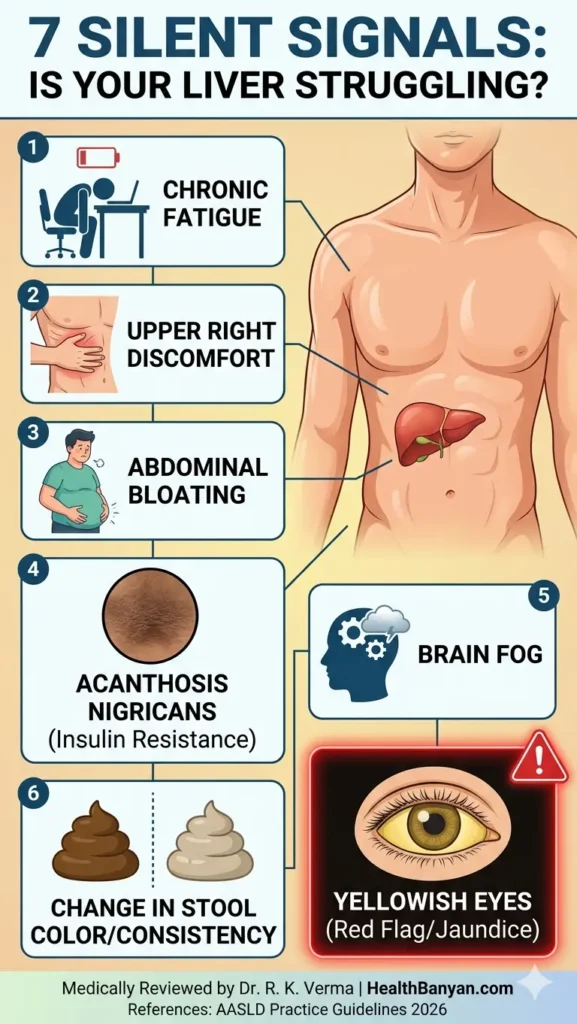
7 SILENT SIGNS & SYMPTOMS
Because the liver has no pain receptors, it won’t “hurt” until it’s late.
Look for these early red flags:
-
-
Chronic Fatigue
-
Feeling tired even after 8 hours of sleep.
-
Upper Right Discomfort
-
A “heaviness” or dull ache just below your right ribs.
-
Dark, velvety patches of skin around the neck or armpits.
-
Difficulty concentrating or feeling “mentally sluggish.”
-
That stubborn “pot belly” that won’t go away.
- Abdominal Bloating
- Belly that stays big – even after trying to lose weight.
-
Acanthosis Nigricans
-
Dark, velvety patches of skin around the neck or armpits.
-
Change in stool colour or consistency
- Stool becomes light yellow or clay-colored instead of normal brown.
-
Brain Fog
-
Difficulty concentrating or feeling “mentally sluggish.”
- Yellowish Eyes (Red Flag)
- Even a slight yellow tint in the whites of the eyes suggests the liver is struggling to process bilirubin. Consult a doctor immediately if this occurs.
-
MYTHS vs. FACTS
-
Myth: Only overweight people get fatty liver.
-
Fact: Lean MASLD is very common in India. Even “thin” people can have dangerous fat around their organs.
-
Myth: You must stop eating all fats to heal the liver.
-
Fact: Healthy fats (nuts, seeds, olive oil) are actually good. It’s sugar and refined carbs that are the real enemies.
-
Myth: “Liver detox” juices will cure it.
-
Fact: Your liver is the detox organ. No juice can replace a consistent, healthy diet and exercise.
-
Myth: Normal liver tests mean normal liver
-
Fact: Many patients with significant fatty liver have near-normal ALT levels.
- Myth: It’s only a liver issue
Fact: MASLD is strongly linked to heart disease—the leading cause of death in these patients.
DOCTOR’S EXPERT OPINION (Dr R. K. Verma)
“MASLD is a lifestyle-driven condition, which means the cure is in your hands. Don’t wait for pain to act; your liver is a silent worker. A combination of disciplined eating and daily movement is more powerful than any supplement on the market today.”
QUICK SUMMARY
-
MASLD is the new name for NAFLD.
-
It is caused by Metabolic issues (Sugar, Weight, Diabetes), not just alcohol.
-
Fatigue and neck darkening are early warning signs.
-
Reversible through 7-10% weight loss and cutting refined carbs.
-
Gold Standard Test: FibroScan.
FAQ SECTION
-
-
Is MASLD dangerous?
-
If ignored, it can lead to MASH, Cirrhosis, and Liver Cancer (rarely). If caught early, it is reversible.
-
-
Why did they change the name from NAFLD?
-
To focus on “Metabolic” causes and remove the stigma associated with the word “Alcoholic.”
-
-
How long does it take to reverse fatty liver?
-
With a strict diet and exercise, many people see significant improvement in 3 to 6 months.
MCQ SECTION
-
What does the ‘M’ in MASLD stand for?
-
A) Muscle
-
B) Metabolic (Correct)
-
C) Medicine
-
-
Which of these is a “silent” sign of liver stress?
-
A) Knee pain
-
B) Unexplained fatigue (Correct)
-
C) Cough
-
-
What percentage of weight loss is usually needed to improve liver fat?
-
A) 1%
-
B) 7-10% (Correct)
-
C) 50%
-
-
Which test measures liver stiffness/scarring accurately?
-
A) X-Ray
-
B) FibroScan (Correct)
-
C) Eye Test
-
-
MASLD is primarily driven by which hormone issue?
-
A) Melatonin
-
B) Insulin Resistance (Correct)
-
C) Adrenaline
-
(Answers: 1b, 2b, 3b, 4b, 5b)
{
“@context”: “https://schema.org”,
“@type”: “MedicalScholarlyArticle”,
“headline”: “MASLD vs. NAFLD: Decoding the New Name and 7 Silent Signs Your Liver Needs Help”,
“author”: {
“@type”: “Organization”,
“name”: “HealthBanyan”
},
“datePublished”: “2026-03-23”,
“description”: “Comprehensive guide on MASLD (formerly NAFLD), its symptoms, causes, and reversal strategies in the Indian context.”,
“medicalAudience”: “Patients”,
“about”: {
“@type”: “MedicalCondition”,
“name”: “MASLD”,
“alternateName”: “Non-alcoholic Fatty Liver Disease”
}
}
REFERENCES
-
AASLD (2024): The multi-society Delphi consensus on new nomenclature for steatotic liver disease.
-
PubMed: Prevalence of MASLD in the South Asian Population: A Systematic Review.
-
ICMR Guidelines: Management of Metabolic Syndrome in the Indian Context.