
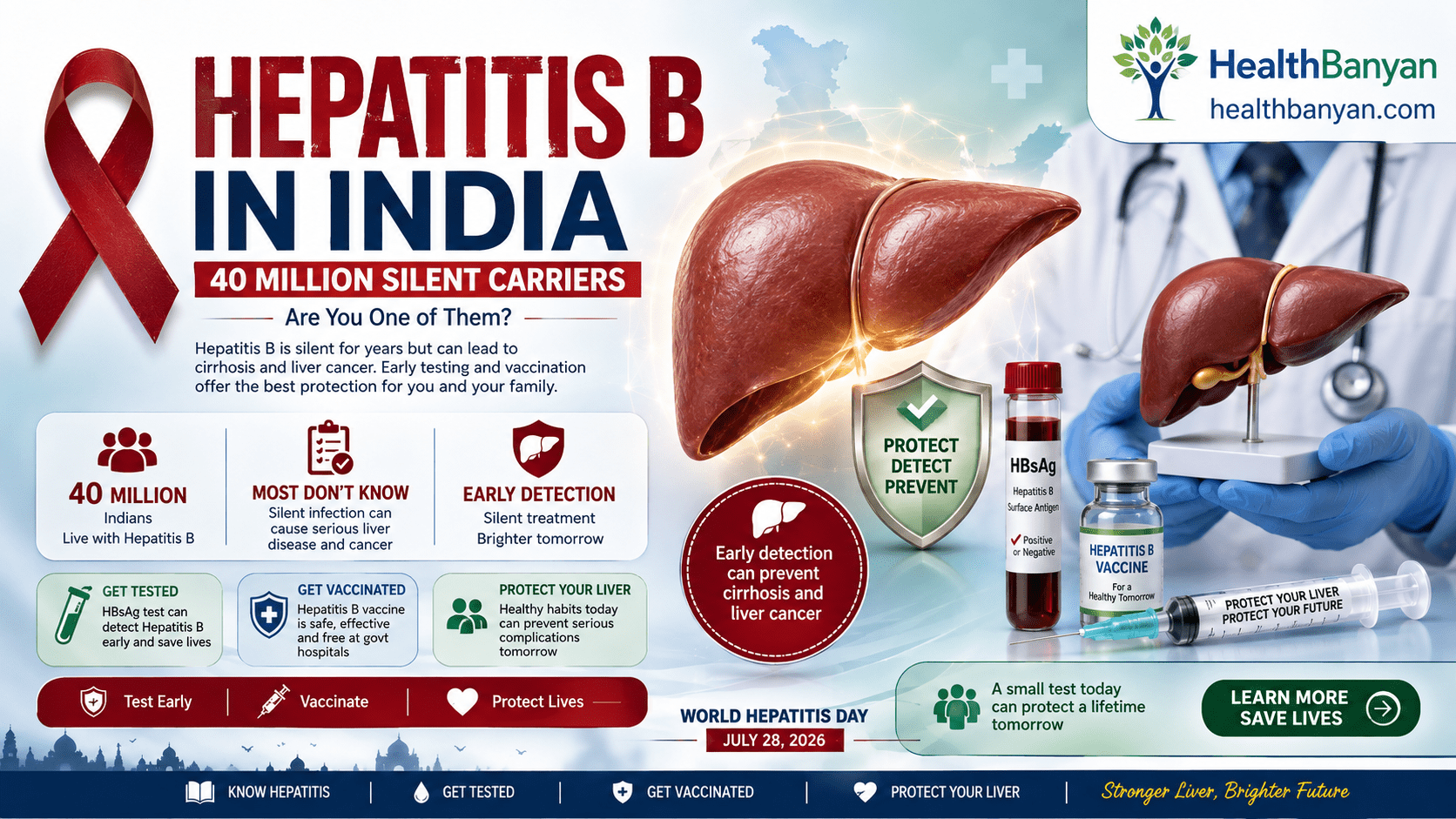
Hepatitis B in India:
40 Million Silent Carriers —
Are You One of Them?
Hepatitis B is one of the most common serious infections in India — and one of the most silent. Most carriers live for decades without a single symptom, unaware that the virus is slowly damaging their liver. By the time symptoms appear, cirrhosis or liver cancer may already be present.
What Is Hepatitis B and Why Does India Have 40 Million Cases?
Hepatitis B क्या है — और भारत में इसके इतने cases क्यों हैं?
Hepatitis B is a viral infection caused by the Hepatitis B virus (HBV) that attacks the liver. Unlike hepatitis A or E — which resolve on their own — Hepatitis B can become chronic (lifelong), silently damaging the liver over decades and eventually causing cirrhosis (permanent liver scarring) or hepatocellular carcinoma (primary liver cancer). Chronic Hepatitis B is defined as HBsAg remaining positive for more than 6 months after infection.
India’s enormous burden — approximately 40 million chronic carriers — is driven primarily by vertical transmission: the virus passing from an infected mother to her baby at the time of birth. This is the most efficient route of HBV transmission and the one that causes lifelong chronic infection most reliably (90% of infants infected at birth develop chronic HBV, compared to only 5–10% of adults). Prior to the inclusion of the Hepatitis B vaccine in India’s Universal Immunisation Programme in 2002, this chain of mother-to-child transmission was completely uninterrupted for generations.
Mother to Child at Birth
30–50% of Indian HBV. Baby exposed to maternal blood during delivery. Without vaccination at birth within 24 hours, 90% become chronic carriers.
Unsterilised Needles
Reused syringes, shared needles, unsterile tattoo and piercing equipment. HBV survives on surfaces for 7 days — far more infectious than HIV.
Healthcare Exposure
Unscreened blood transfusions (pre-2000), needlestick injuries in healthcare workers, and surgical procedures with unsterilised equipment.
Sexual Contact
Through exchange of blood or body fluids with an infected person. Less efficient than mother-to-child but significant in sexually active adults.
Hepatitis B is NOT spread by sharing food, water, plates, or utensils. It is NOT spread by hugging, shaking hands, coughing, sneezing, or casual contact. You cannot get Hepatitis B from sitting near an infected person, sharing a toilet, or kissing on the cheek. These misconceptions cause enormous unnecessary stigma in India — people with Hepatitis B are sometimes isolated by their own families based on misinformation. The virus is in blood and body fluids only, not in saliva, tears, sweat, urine, or faeces.
Hepatitis B खाने-पीने से, छूने से, गले लगाने से, या साथ बैठने से नहीं फैलता। यह केवल blood और body fluids से फैलता है।Who Should Get the HBsAg Test — High-Risk Groups in India
किसे Hepatitis B का test करवाना चाहिए — अभी, बिना देरी किए
The honest answer: every Indian adult above 18 who has never been tested for HBsAg should get the test once. HBV is so prevalent in India that universal adult screening is a reasonable public health approach. However, the following groups are at particularly high risk and must not delay:
Children born before 2002 or to unvaccinated mothers
The HBV vaccine was added to India’s UIP only in 2002. Adults who were born before this year, or born to mothers who were not screened during pregnancy, may be chronic HBV carriers without knowing it.
Healthcare workers — doctors, nurses, lab technicians
Needlestick injuries and exposure to patient blood place healthcare workers at significantly elevated risk. All healthcare workers who are not already vaccinated or confirmed immune (anti-HBs positive) should test and vaccinate immediately.
Anyone who received a blood transfusion before 2000
Routine HBsAg screening of blood donors became mandatory in India in the late 1990s. Blood transfusions before this era carry a meaningful HBV transmission risk. One test now could reveal an infection contracted decades ago.
Family members of a known HBsAg-positive person
HBV spreads within households through shared razors, toothbrushes, and minor blood contact. If any family member is HBsAg positive, all household contacts should be tested and, if negative, vaccinated urgently.
All pregnant women — at the first antenatal visit
HBsAg testing is recommended for all pregnant women in India. If the mother is HBsAg positive, the baby must receive the Hepatitis B vaccine within 24 hours of birth (the birth dose) plus Hepatitis B Immunoglobulin (HBIG). This combination prevents vertical transmission in 95% of cases.
🔬 How to Read Your Hepatitis B Test Results
Hepatitis B Treatment in India — What Is Available, What It Costs, and Who Needs It
Hepatitis B का इलाज भारत में उपलब्ध है — जानिए कौन से medicines, कितना खर्च
Chronic Hepatitis B is not cured by current medicines — but it is controlled. The goal of antiviral treatment is to suppress HBV DNA to undetectable levels, normalise liver enzymes, prevent liver damage progression, and dramatically reduce the risk of cirrhosis and liver cancer. This is achievable in most patients on treatment.
The two preferred first-line antivirals in India (as per AASLD, EASL, and Indian SGEI guidelines): Tenofovir Disoproxil Fumarate (TDF) — the preferred first-line agent; available as generic in India (Hepbest, Tenvir, and others) at Rs 300–600 per month; also available free under NVHCP at government facilities. Entecavir — equally effective first-line option; available generic at Rs 400–700 per month. Both are oral once-daily tablets with excellent safety profiles and very low resistance rates. Treatment duration: typically lifelong (HBsAg rarely clears with antivirals), with rare exceptions in HBeAg-positive patients who achieve HBeAg seroconversion.
Treatment is indicated when: HBV DNA is above 2,000 IU/mL AND liver enzymes (ALT) are elevated OR FibroScan shows significant fibrosis (F2 or above). Treatment regardless of DNA level: all cirrhotic patients (F4); all HBsAg-positive pregnant women in the third trimester (to prevent vertical transmission); all patients about to start immunosuppressive therapy (chemotherapy, biologics, steroids). If HBV DNA is low and ALT is persistently normal and there is no fibrosis — the patient may be in the “immune tolerant” or “inactive carrier” phase and may not need treatment yet, but requires 6-monthly monitoring. Never start or stop HBV treatment without a hepatologist’s assessment.
HBsAg positive = treatment नहीं necessarily। Hepatologist से HBV DNA, LFT, और FibroScan के basis पर decision लें।Share on WhatsApp
Help someone get tested — one share could save a liver.